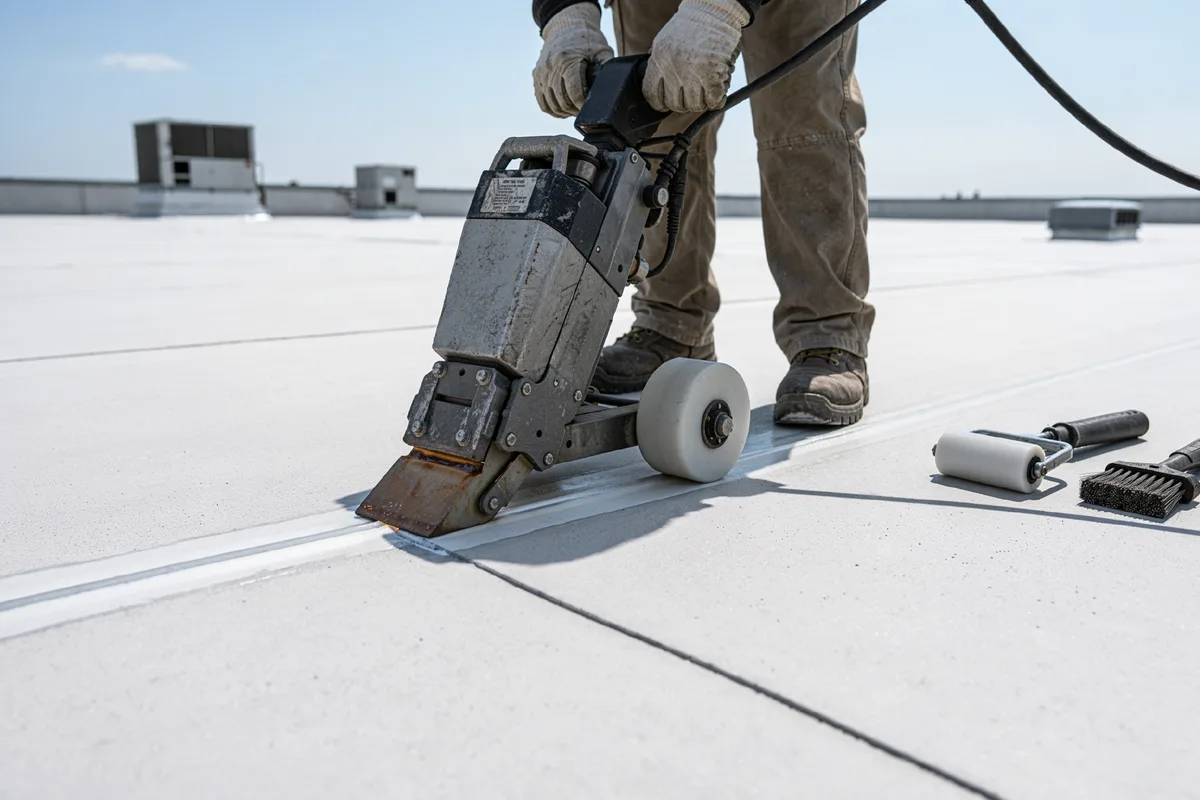
The strength of a TPO roof lies in its welded seams, so workmanship matters as much as the material. A roofer tests those seams and details every wall, pipe and corner. Call the number on this page to be connected with a local roofing contractor in Bainbridge Island.
Single-ply, explained plainly
Instead of stacked layers of asphalt, a single-ply roof relies on one flexible sheet. That sheet is thinner and lighter, so it puts less load on framing. Its weakness is that everything depends on the quality of the seams and flashings. That tradeoff is the heart of the choice for any building.
Common seam problems
- Cold welds that never fully fused
- Burned or wrinkled seam edges
- Dirt or moisture trapped in the overlap
- Unsealed cut edges on reinforced sheets
Any of these can open over time and let water in. A careful roofer rechecks seams, since small flaws are easy to fix before leaving.
Salt air near the water corrodes exposed fasteners and metal edging, so ask the roofer which materials hold up in that setting.
Shade from big trees keeps a TPO roof damp and lets algae grow, so occasional gentle cleaning helps keep the surface light.
Access and logistics
Roofers may need a crane, hoist or staged materials for a tall or tight site. Closed streets, tenant parking and narrow alleys all add effort. Mention access issues early so the estimate is realistic. Photos of the roof and access route help the roofer estimate before the visit.
TPO in a wet, mild climate
A long rainy season and mild temperatures suit single-ply roofs. The sheet sheds water, the welds keep it out, and the white surface stays cleaner with occasional washing. Drains must stay clear, since a flat roof has little slope. Regular drain checks matter most in the wettest months.
Choosing between repair and replacement
A few punctures or seams on a young roof call for repair. Brittle sheets, many failing welds or wet insulation point to replacement. A roofer can show you moisture readings and photos to support the recommendation. Ask the roofer to explain what each option would involve and cost.
Before you call in Bainbridge Island
Building permits for Bainbridge Island homes are handled by the City of Bainbridge Island permit office. Small repairs often need nothing, while a tear-off, new sheathing or structural work usually does, so ask the roofer who pulls the permit.
Washington L&I registers construction contractors. Its free lookup shows whether a roofer's registration is active and whether there are claims against it.
On the island, wind off the water and salt spray are hard on fasteners and flashing. Ask whether the company already works on Bainbridge Island homes.
Most roof trouble in this part of Washington shows up in the wet season, when a small gap in flashing or a lifted shingle has months of rain to work on.
Tall evergreens around Bainbridge Island drop needles that fill valleys and gutters and keep roofs shaded and damp, which is where moss starts.
Nearby, the same kind of help is available in Suquamish, Indianola and Silverdale.
TPO Roofing questions in Bainbridge Island
What does TPO stand for?
Is TPO good for a residential flat roof?
What is the difference between TPO and torch-down?
How does a TPO roof handle foot traffic?
More roofing services in Bainbridge Island
TPO Roofing nearby
Helpful guides
Sources
Last updated: